Wedding Gift Registry: how to create a registry that works
It used to be simple: you went to a department store, chose crockery, cutlery, and towels, and guests bought something from the list. These days, most couples already have a complete household. The third fruit basket or fifth painting is well-meant, but not exactly what you are hoping for.
A gift registry in 2026 looks different. Couples increasingly opt for cash wishes, honeymoon contributions, or a mix of physical and digital gifts. But how do you put together such a list? What is the etiquette? And how do you communicate it to your guests without coming across as greedy?
Why a gift registry?
A gift registry is not mandatory, but it makes things easier for everyone. Guests know what you want. You do not end up with three of the same thing. And nobody has to feel awkward about the amount.
Without a registry, one of two things happens: guests ask around what you want (meaning your parents and best man/maid of honour get the same question over and over), or they come up with something themselves. That can turn out beautifully, but it can also result in a collection of random items that do not suit you at all.
With a registry, you provide direction. Not pushy, but helpful. Guests who prefer to do their own thing will do so anyway. The rest are happy to have a list.
Types of gift registries
The classic registry
The traditional approach: a list of physical products. Crockery, kitchen appliances, bedding, home accessories. This works well if you have just moved in together or are furnishing a new home.
The downside: if you have been living together for years and already have a complete household, the list runs dry quickly. And then you end up adding things you do not actually need, just to fill it.
Cash wishes
Increasingly popular: a list of cash wishes. "Contribution to the honeymoon," "New sofa for the living room," "Savings for the renovation." Guests donate an amount of their choice, and you spend it on what you want.
The advantage is flexibility. The downside is that some guests find it impersonal. Not everyone enjoys giving money, even when it is "for the honeymoon." Respect that.
Group gifts
A middle ground: big wishes that multiple guests contribute to together. A €500 espresso machine? Five guests each contributing €100. A nice camera? Ten guests each giving €50.
Group gifts work well for more expensive items you really want but that are too pricey for a single guest. It also gives guests the option to choose an amount that fits their budget.
The mix
Most couples end up choosing a combination. A few physical wishes for guests who like to give something tangible. A few cash funds for bigger plans. And always an option for a free contribution, for guests who want to choose their own amount.
The envelope at the wedding
In many European countries, a cash envelope at the wedding is still very common. Guests put money in an envelope and give it on the day. There is nothing wrong with that, and many couples count on it.
But it has drawbacks. You do not know in advance what you will receive, so it is hard to base plans on. Guests do not know how much is "appropriate" and sometimes feel uncomfortable. And after the wedding, you are left with a pile of envelopes and no overview of who gave what (unless you track it, but who does that during their own party?).
A digital gift registry solves these problems. Guests see what is available, choose an amount that works for them, and you have an overview. The envelope can exist alongside it, for guests who prefer that.
Etiquette: how to communicate your registry
This is where it gets tricky for many couples. You want to inform your guests about the registry, but you do not want to come across as someone asking for gifts. That is understandable.
A few guidelines:
Not on the invitation. The wedding invitation is an invitation, not a wish list. Refer to the registry on your wedding website, or include a separate card with the invitation that mentions it.
Let others spread the word. Best man, maid of honour, parents, and MC are often asked what you want. Give them the link to the registry so they can share it.
Keep it low-key. A line like "If you would like to give something: there is a wish list on our wedding website" is perfectly fine. Short, honest, no pressure.
Always include a free option. Not every guest wants to pick from a list. Make sure there is room for a free contribution or a gift at their own discretion.
Thank-you notes. Anyone who chose something from the list or made a contribution deserves a personal thank-you. Not a generic line, but a few words that show you know what they gave. An overview in your registry tool makes this easier.
What to put on the list
The content of the registry depends on your situation. But a few principles always apply:
Variety in price range. Not just items at €200. Include wishes at €20, €50, and €100 as well. Not every guest wants or can spend the same amount, and that is perfectly fine.
Put things on it you actually want. No filler. If you do not need new cutlery, do not add it. Guests can tell the difference between a genuine wish and list padding.
Think about experiences. A cooking class, a wine tasting, a night in a hotel. Not everything has to be a physical object.
Be specific with cash wishes. "Honeymoon contribution" is vague. "Diving course in Bali" or "Dinner in Paris" gives guests the feeling they are contributing to something tangible.
When to set up the registry
Start thinking about the gift registry 6 to 9 months before the wedding. Publish the list at the latest when the invitations go out, so guests can access it from the start.
A timeline:
- 6 to 9 months before the wedding: discuss together what you want. Walk through your home, see what you are missing or want to replace.
- 4 to 6 months: create the list and put it online.
- 3 to 4 months: share the link via the wedding website or with the invitations.
- After the wedding: review the overview, send thank-you cards.
Add the gift registry to your wedding checklist so you do not forget it.
Digital registry vs. store registry
A store registry (at a department store or online shop) has the advantage that guests can buy the gift directly and have it delivered. The downside: you are limited to that one store's selection, and cash wishes are often not possible.
A digital gift registry offers more freedom. You decide what goes on it, including cash funds, group gifts, and free contributions. Guests see exactly what is available and what has already been claimed.
The key difference: with a store registry, the money goes to the store. With a digital registry with cash wishes, the money goes to you. That gives you the freedom to spend it wherever you want.
Common mistakes
Publishing too late. If guests are already asking what you want long before the wedding and there is no list yet, they will come up with something themselves. Publish on time.
Only expensive items. A list with nothing under €100 puts guests off. Make sure there is variety.
Too much explanation. Guests do not need an essay about why you want a new blender. A brief description is enough.
No thank-you notes. It sounds like basic etiquette, and it is. Yet many couples forget to send personal thank-you notes. Do it, preferably within two months after the wedding.
Not keeping the list updated. If guests claim something but it is not updated, you end up with duplicate gifts. With a digital tool, this is tracked automatically.
Create your registry with Folio
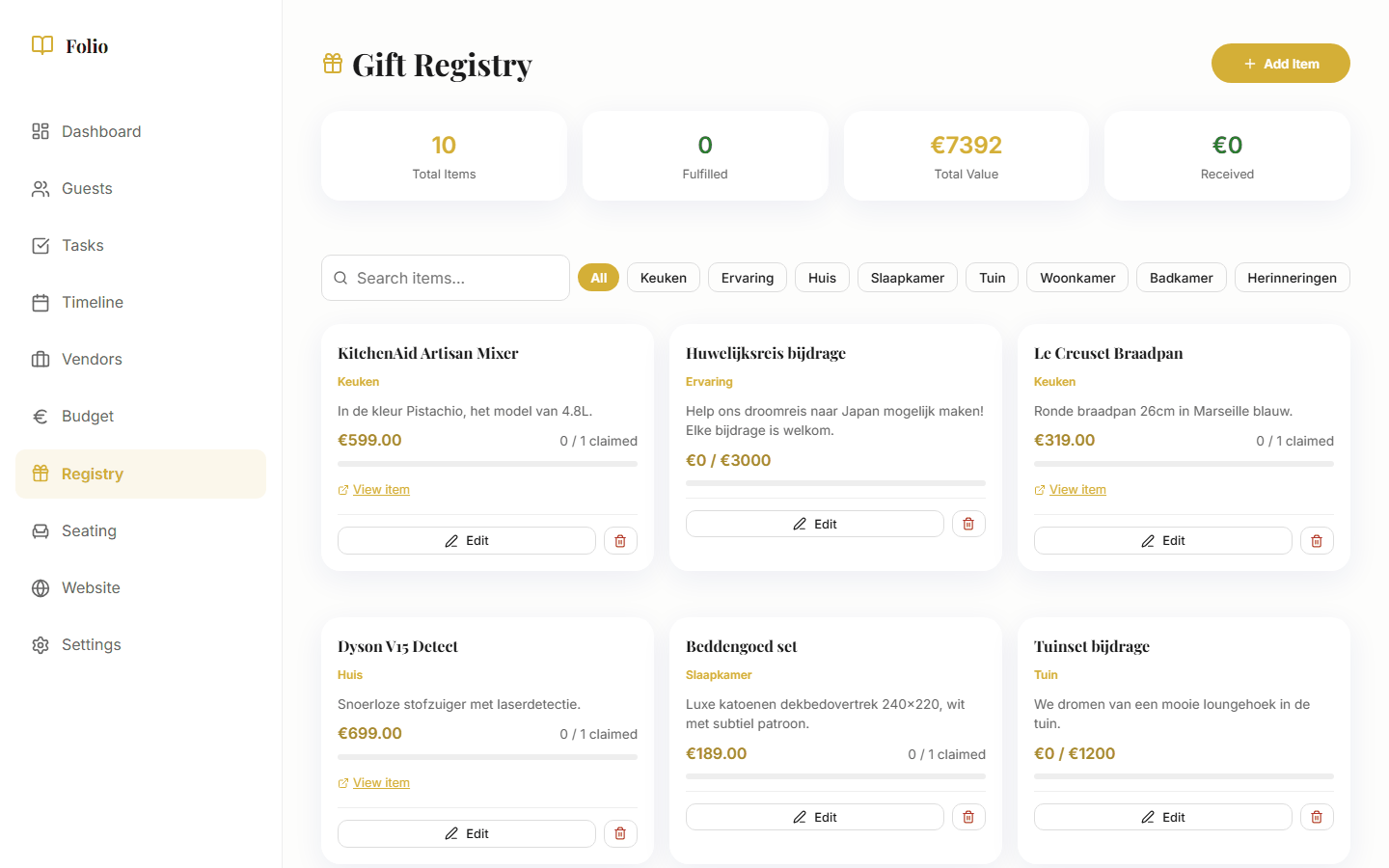
In Folio, you create a gift registry that does exactly what you need. Physical wishes, cash funds, group gifts: it all works. Guests open the registry via your wedding website, see what is available, and claim a wish or contribute to a fund.
You see in the overview what has been claimed, who contributed what (handy for thank-you notes), and how much is in the cash funds. No spreadsheets, no separate lists, no confusion.
The gift registry is connected to your wedding website, so guests have direct access. And it is part of the same app where you also track the guest list, the budget, and the timeline.