Wedding Seating Chart: tips for a successful layout
The seating chart is one of those tasks you keep putting off until you absolutely cannot avoid it any longer. And then it turns out to be harder than expected. Because it is not just about "who sits where" — it is about family dynamics, friendships, table shapes, the layout of the venue, and the fact that Uncle Karl and Aunt Mary have not spoken to each other in three years.
The good news: with a systematic approach, it is a solvable problem. In this article, we walk through everything: when to start, which table layout fits your wedding, how to handle tricky situations, and how to work it out in practice.
When do you start the seating chart?
Not too early. The seating chart is one of the last steps in the planning, because you first need to know who is actually coming. There is little more frustrating than a perfectly worked-out seating chart that you have to redo entirely because five guests cancelled and three others confirmed last minute.
The ideal time: two to four weeks before the wedding, after the RSVP deadline has passed and you have the final guest count. More about collecting RSVPs in our RSVP article.
That does not mean you should not think about it earlier. You can determine the broad strokes well in advance: which table layout, where the couple sits, and which groups of guests belong together. But assigning specific names to seats — that you do once you know who is coming.
Table layouts: round tables, long tables, or a combination
The choice of table layout depends on the venue, the number of guests, and the atmosphere you want. Each option has pros and cons.
Round tables
The most commonly used layout at weddings. Round tables for 8 to 10 people, spread across the room.
Advantages:
- Everyone at the table can talk to everyone. There is no "end of the table" where people feel left out.
- Flexible in number. One guest more or fewer is easy to accommodate.
- Groups form naturally: a table for the in-laws, one for colleagues, one for the friend group.
Disadvantages:
- Guests mainly talk to their immediate neighbours. Contact with other tables is limited.
- Round tables take up more floor space than long tables.
Long tables
Long tables are especially popular for smaller weddings or venues with a rectangular layout. Think of barns, restaurants, and manor houses.
Advantages:
- Atmospheric and intimate. It feels like a big family dinner.
- More space-efficient. Long tables fit better in narrow rooms.
- Fewer tables to decorate.
Disadvantages:
- Guests only talk to their immediate neighbours (the two beside them and two across). The rest of the table is too far away.
- Less flexible. Adding or removing a guest shifts the entire row.
- With a large group, you need multiple long tables, which negates the intimacy advantage.
U-shape or E-shape
A long table in a U or E formation, with the couple at the short side. Sometimes seen at more traditional weddings.
Advantages:
- The couple sits centrally and can see everyone.
- Good for speeches, as all guests face the same direction.
Disadvantages:
- Guests at the ends sit far from the couple.
- Requires a large, wide room.
- Feels more formal than round tables.
Combination
More and more couples combine table types: a long table for the couple and immediate family, with round tables for the remaining guests. This gives the best of both worlds: intimacy for the core group, flexibility for the rest.
The couple: where do you sit?
There are three common options:
Sweetheart table. Just the couple at a small table, with a view of the room. This gives you a quiet moment together during dinner, but it can also feel like you are sitting apart from everyone else.
At the head table. Together with the witnesses, parents, or best friends. The classic choice. The downside: the table can get large, and not everyone enjoys dining next to the in-laws.
Among the guests. Simply at one of the round tables, with your best friends or immediate family. Informal and relaxed, but then the "head table" is missing a couple.
There is no wrong choice. Pick what suits you. The only thing that matters: make sure you have a view of the room, so you can follow speeches and toasts easily.
Who sits with whom?
This is the real work. A few principles that help:
Group by connection
People who know each other sit together. The friend group with the friend group, colleagues with colleagues, family with family. That sounds obvious, but it also means you sometimes end up with a "leftover table" of people who do not know anyone else. We will get to that.
Keep households together
Couples sit next to each other, unless they prefer otherwise. A family with children sits together. This is the baseline. More about households and your guest list in our guest list guide.
Think about dynamics
At every table, you want at least a few people who can keep the conversation going. Do not put all the quiet guests together. And do not put all the loud guests together (unless you want a party table — but the neighbouring table will be less than thrilled).
Family: separate or mixed?
The question every couple faces: do the two families sit mixed or separate? Both work. Mixed tables help families get to know each other. Separate tables feel more familiar, especially if the families do not know each other well yet.
A middle ground: parents and immediate family at the head table or with the couple. The rest of each family at their own tables, possibly with a few people from the other side mixed in.
The leftover table
At virtually every wedding, there are guests left over who do not fit into a natural group. Your partner's colleague. Your parents' neighbour. The plus-one of a friend who does not know anyone else.
Do not call it a leftover table. Make it a deliberate table. Seat a few sociable guests there who can easily start a conversation. Make sure there is something in common, even if it is just age or their connection to the couple.
Children
With families with young children (up to about six), the children sit with their parents. Not much you can arrange there.
With older children (six to twelve), a children's table can be an option. Children often enjoy sitting together, and parents can eat in peace. Just make sure someone keeps an eye on them.
Teenagers usually prefer to sit with their parents or with peers rather than at a children's table. Treat them as adults in the seating arrangement.
Practical tips
Work visually. A list of names and table numbers is abstract. A visual floor plan where you can drag and shuffle people gives much better overview. Post-its on paper work, but a digital tool is easier to adjust.
Start with the core. Seat the couple, parents, witnesses, and immediate family first. Those are the easy placements. Then work outward: close friends, extended family, colleagues, acquaintances.
Calculate with the right numbers. Ask your venue how many chairs fit per table. A round table for 8 is different from one for 10. And do not forget the space for chairs, the waitstaff route, and the path to the restrooms.
Consider the room layout. Tables near the kitchen door or restrooms are less popular. Do not put your most important guests there. The table near the dance floor is fun for the party, but less so during dinner if the music has already started.
Share the result. The venue and caterer need the seating chart, especially if there are dietary requirements. The MC does too, for guiding guests to their seats. Export the seating chart or print an overview.
Common mistakes
Starting too early. Making a seating chart while half the guests have not responded yet is a waste of time. Wait until the final guest count is confirmed.
Seating people who do not get along next to each other. It sounds obvious to avoid, but it happens more often than you think. Especially with family conflicts the couple is not fully aware of. Ask your parents if there are tensions you should know about.
Not accounting for the waitstaff. Tables that are too close together cause problems during serving. Follow your venue's guidelines.
Deciding everything alone. The seating chart is something you should absolutely do together. You each know "your" guests best. And ask parents for help with the family tables — they know who can and cannot sit next to whom.
Chasing perfection. There is no perfect seating chart. There is always someone who would rather have sat somewhere else. The goal is not perfection, but making sure everyone has a pleasant evening. That works if you avoid the big problems (conflicts, someone who knows nobody) and let go of the rest.
Create your seating chart with Folio
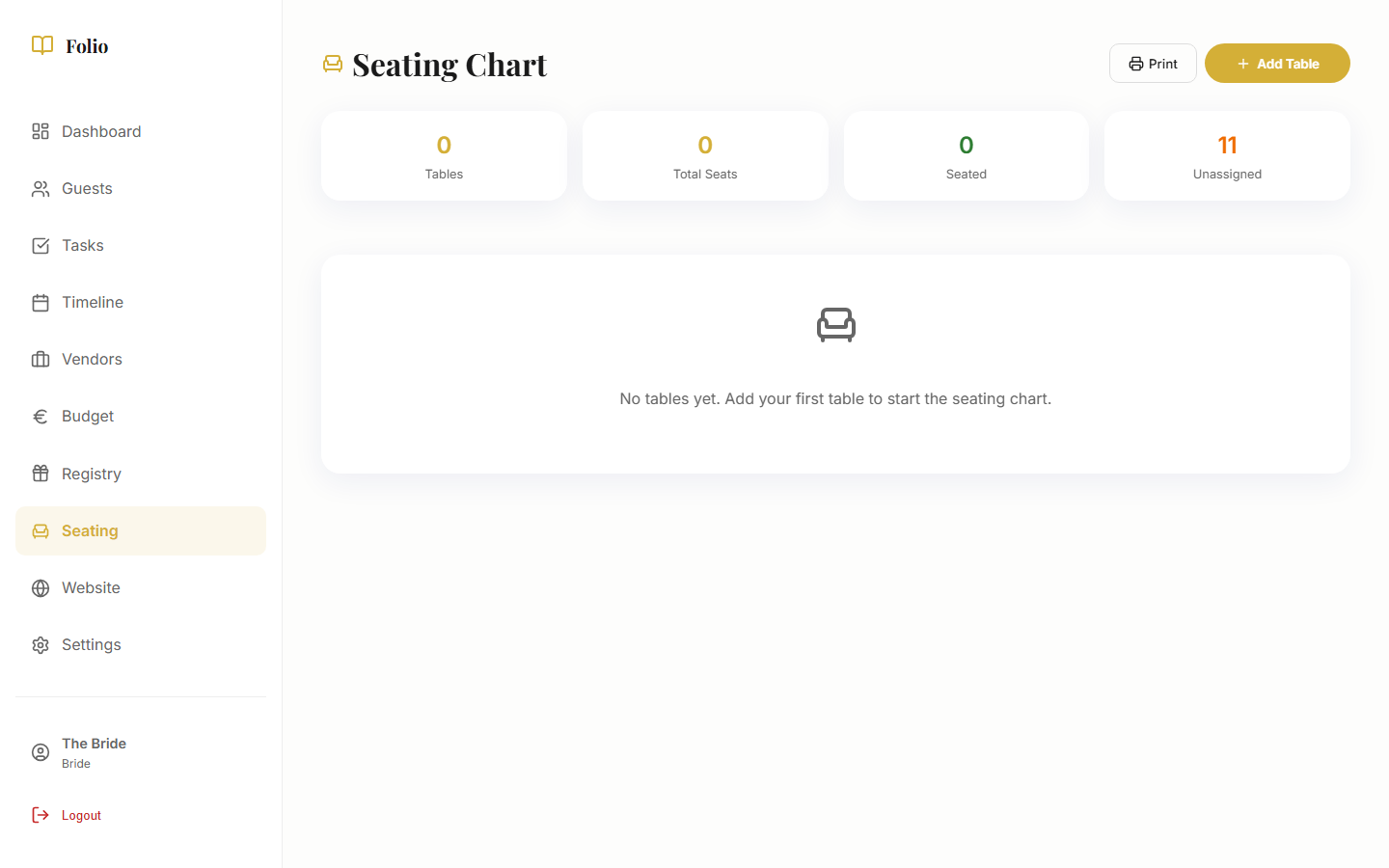
In Folio, you create the seating chart visually. You see the tables on a floor plan and drag guests to their seat. The guest list is connected, so you can immediately see who has confirmed, who eats vegetarian, and which guests belong to the same household.
Round tables, long tables, a mix: it all works. Add tables, give them a name or number, and assign guests. The overview is always current, and you can export it as a PDF for the venue, caterer, or MC.
The seating chart is part of the same app where you also track the guest list, the budget, the timeline, and the gift registry. Everything in one place, everything up to date.