What does a wedding cost in 2026? Real figures and sample budgets
The first question every couple asks: what does a wedding actually cost? The honest answer: more than you think. The average European wedding costs between €15,000 and €25,000. That is a car. Or a renovation. Or a year of eating out every week.
But that average does not say much. A wedding with 40 guests at a restaurant is a completely different story from a wedding with 150 guests at a country estate. What we do here is make it concrete: real figures by category, so you know where the money goes and where you can make adjustments. Want to know when to book each vendor? Check our wedding checklist with 100+ tasks.
Wedding costs by category
Below is a realistic breakdown of costs for a wedding in 2026. The figures are based on what couples typically spend. Your numbers can be significantly higher or lower depending on your choices.
Venue
| Item | Average | Range |
|---|---|---|
| Ceremony (civil/church) | €400 | €150 – €800 |
| Reception venue (hire) | €2,500 | €500 – €8,000 |
The venue is often the biggest single cost. A country estate or castle can run to €5,000–8,000 just for hire. A restaurant or community hall is a fraction of that. The difference also lies in what is included: some venues supply tables, chairs, crockery, and staff. At others, you rent everything separately.
Catering
| Item | Average per person | For 80 guests |
|---|---|---|
| Reception (drinks + canapes) | €15 – €25 | €1,200 – €2,000 |
| Dinner (3-course menu) | €55 – €85 | €4,400 – €6,800 |
| Evening buffet / snacks | €10 – €20 | €800 – €1,600 |
| Drinks (entire day) | €25 – €45 | €2,000 – €3,600 |
Catering is almost always the largest total expense when you add it all up. With 80 guests, you are easily looking at €8,000–12,000 for food and drinks combined. This is also the biggest lever: the number of guests multiplies every euro you spend per person.
Photography and video
| Item | Average |
|---|---|
| Photographer (full day, ~10 hours) | €2,000 – €3,500 |
| Videographer (full day) | €1,500 – €3,000 |
| Photographer (half day, ~5 hours) | €1,200 – €2,000 |
Do not cut corners here too quickly. The photos are the only thing you keep after the wedding day (besides the memories and perhaps a dent in your bank account). A good photographer for €2,500 who stays all day is worth it.
Music and entertainment
| Item | Average |
|---|---|
| DJ (evening party, ~5 hours) | €600 – €1,200 |
| Live band (evening party) | €1,500 – €4,000 |
| Ceremony music (string duo, singer) | €300 – €800 |
A DJ for the party is the most common choice. A live band costs more but creates a different atmosphere. Whatever you choose: book early. Good DJs and bands are booked months in advance during wedding season.
Flowers and decoration
| Item | Average |
|---|---|
| Bridal bouquet | €80 – €200 |
| Corsages and other flowers | €150 – €400 |
| Table decorations | €300 – €1,500 |
| Other decor (garlands, welcome sign, etc.) | €200 – €800 |
Flowers are more expensive than you expect. A bridal bouquet for €150 is perfectly normal, and you still have nothing on the tables. Seasonal flowers are cheaper: a peony in December costs twice as much as in June.
Attire and styling
| Item | Average |
|---|---|
| Wedding dress | €1,200 – €3,000 |
| Wedding suit | €400 – €1,200 |
| Bridal accessories (veil, shoes, jewellery) | €200 – €600 |
| Makeup artist + hairstylist | €300 – €600 |
The wedding dress is emotionally the biggest purchase, but not necessarily financially. Do not forget the hidden costs: alterations run €200–500, bridal shoes €100–300, and the day-of makeup artist €300–500 (including a trial).
Wedding rings
| Item | Average |
|---|---|
| Two wedding rings (gold) | €600 – €2,000 |
Depends heavily on the material and whether you choose a jeweller or goldsmith. White gold or platinum costs more than yellow gold. Diamonds? Add €500–2,000.
Stationery
| Item | Average |
|---|---|
| Save the Date | €100 – €250 |
| Wedding invitations (80 pcs) | €200 – €500 |
| Menu, place cards, program | €100 – €300 |
| Thank-you cards | €80 – €200 |
Designing and ordering online is cheaper than hiring a graphic designer. But if you want a specific style that matches the rest of the wedding, a designer can make a real difference.
Other costs
| Item | Average |
|---|---|
| Wedding cake | €200 – €600 |
| Wedding transport | €200 – €800 |
| Wedding favours | €100 – €300 |
| Wedding insurance | €100 – €250 |
| Wedding night (hotel) | €150 – €400 |
| Tips | €100 – €300 |
Everyone forgets the tips. MC, DJ, driver: it is not mandatory, but it is customary. Set aside €200 in cash.
Wedding cost by guest count
This is the table everyone is looking for. Guest count is the biggest cost driver: each guest costs you roughly €100–180 extra (food, drinks, favour, chair). Below is an estimate for an average wedding in 2026.
| Guest count | Estimated total cost | Of which catering |
|---|---|---|
| 40 guests | €10,000 – €16,000 | €4,000 – €6,500 |
| 50 guests | €12,000 – €18,000 | €5,000 – €8,000 |
| 80 guests | €16,000 – €24,000 | €8,000 – €12,000 |
| 100 guests | €18,000 – €28,000 | €10,000 – €15,000 |
| 150 guests | €24,000 – €38,000 | €15,000 – €22,000 |
| 200 guests | €30,000 – €48,000 | €20,000 – €30,000 |
A few things to keep in mind:
Fixed costs stay the same. Photographer, DJ, wedding dress, rings: you pay for those whether you have 40 or 150 guests. With a smaller wedding, fixed costs make up a larger share of the total.
Evening-only guests are cheaper. A guest who only comes for the evening costs €30–50 (drink, snack, slice of cake). A full-day guest costs €120–180. If your budget is tight: invite more people for the party only.
Children count too. A children's menu is cheaper (€20–35), but they still take up a chair and a plate. Do not forget them in the budget.
Sample wedding budget: 80 guests
To make it tangible, here is a sample budget for a wedding with 80 guests (a fairly common number).
| Category | Amount | % of total |
|---|---|---|
| Venue (ceremony + party) | €2,900 | 15% |
| Catering (food + drinks) | €9,500 | 48% |
| Photographer | €2,500 | 13% |
| Music (DJ + ceremony music) | €1,000 | 5% |
| Flowers and decoration | €1,200 | 6% |
| Attire and styling | €2,200 | 11% |
| Wedding rings | €800 | 4% |
| Stationery | €400 | 2% |
| Other (cake, transport, favours, etc.) | €800 | 4% |
| Total | €21,300 | 100% |
Two thirds of the budget goes to venue and catering. That is normal. If you want to save, that is where the biggest gains are, but also the biggest impact on the experience.
Rules of thumb for your wedding budget
If you are just starting out with no idea where to begin:
- Catering + venue: 50–60% of total budget
- Photography: 10–15%
- Attire and styling: 8–12%
- Flowers and decoration: 5–8%
- Music: 3–6%
- Stationery and other: 5–10%
- Buffer for unexpected costs: 5–10% (seriously, set this aside)
That buffer is not a luxury. There is always something that costs more than budgeted. The venue that charges a surcharge for cleanup after midnight. The florist who cannot source seasonal flowers and switches to more expensive varieties. The rain scenario that requires extra tent sections.
Saving on your wedding (without it showing)
Saving does not have to mean a bare-bones affair. It is about spending money on the things that matter to you and cutting back on the rest.
Get married on a weekday. A Friday or Monday is €500–2,000 cheaper at many venues than a Saturday. Most guests take a day off for it, and it feels just as festive.
Limit the number of full-day guests. The fastest way to trim your budget. Ten fewer guests at dinner saves €1,000–1,800. Invite the rest for the evening party. Nobody minds.
The season makes a bigger difference than you think. Getting married in November or January is cheaper than June or September: venues offer discounts in the off-season, and seasonal flowers cost less. Combine that with a venue where catering is included, and you save twice. External catering plus rental of cutlery, crockery, tables, and staff adds up fast. A restaurant or banquet hall that includes everything is sometimes cheaper overall than a "cheaper" bare venue.
Do (some of) the decoration yourself. Table decorations are easy to save on. Candles, small vases with wildflowers, a few branches. It does not need to come from a stylist to look beautiful. But be honest with yourself: if you do not feel like it, outsource it. DIY under stress is not a saving.
Digital invitations. A nice online invitation saves €300–500 and reaches your guests faster. Not everyone finds this appropriate, but more and more couples are choosing it. Your timeline does not need an expensive print shop either: a digital version works better.
Skip the open bar. Unlimited drinks sounds generous but costs €35–50 per person. A drink token system or limited arrangement (wine with dinner, beer and soft drinks in the evening) saves hundreds of euros.
Skip what you do not care about. No videographer needed? Save €2,000. No five-tier wedding cake? A simple cake for €150 tastes just as good. You do not have to do everything that is "expected." Spend money on the things you enjoy.
Hidden costs you almost forget
A few items that rarely appear in the first version of the budget:
- VAT. Some vendors quote prices excluding VAT. Always ask whether the amount includes it. An extra 21% is a nasty surprise.
- Trial appointments. Trial makeup (€75–150), tasting dinner (€50–100 p.p.), cake tasting. It adds up.
- Travel and accommodation. Wedding night, hotel the evening before, taxis on the day.
- Dress alterations. Almost every dress needs to be altered: €200–500.
- Accessories. Veil, cufflinks, corsages, guest book, ring pillow, all €20–100 each, together hundreds of euros.
- Late-night surcharge. Many venues charge extra if the party continues past midnight: €200–500.
- Cleanup costs. Some venues charge a cleaning surcharge.
How to set up a wedding budget
Step by step, without spreadsheet stress:
1. Determine the total budget. What can and do you want to spend? Add up your own savings, any contributions from parents, and what you can save in the coming months. Be realistic: planning a wedding with money you do not have yet creates stress.
2. Divide across categories. Use the rules of thumb above as a starting point. Always keep 5–10% as a buffer.
3. Research and request quotes. Only after real quotes do you know if your budget works. Ask every vendor what is and is not included.
4. Adjust. After the first round of quotes, it never adds up. That is normal. Look at where you are over budget and where you can shift things. Maybe the venue is more expensive than expected but the photographer is cheaper. Adjust the allocation.
5. Keep tracking. This is the hardest part. Quotes, deposits, remaining balances, unexpected costs. It quickly gets messy if you are not actively tracking it. With a wedding planning app you track quotes, deposits, and balances without spreadsheet stress.
Track your budget with Folio
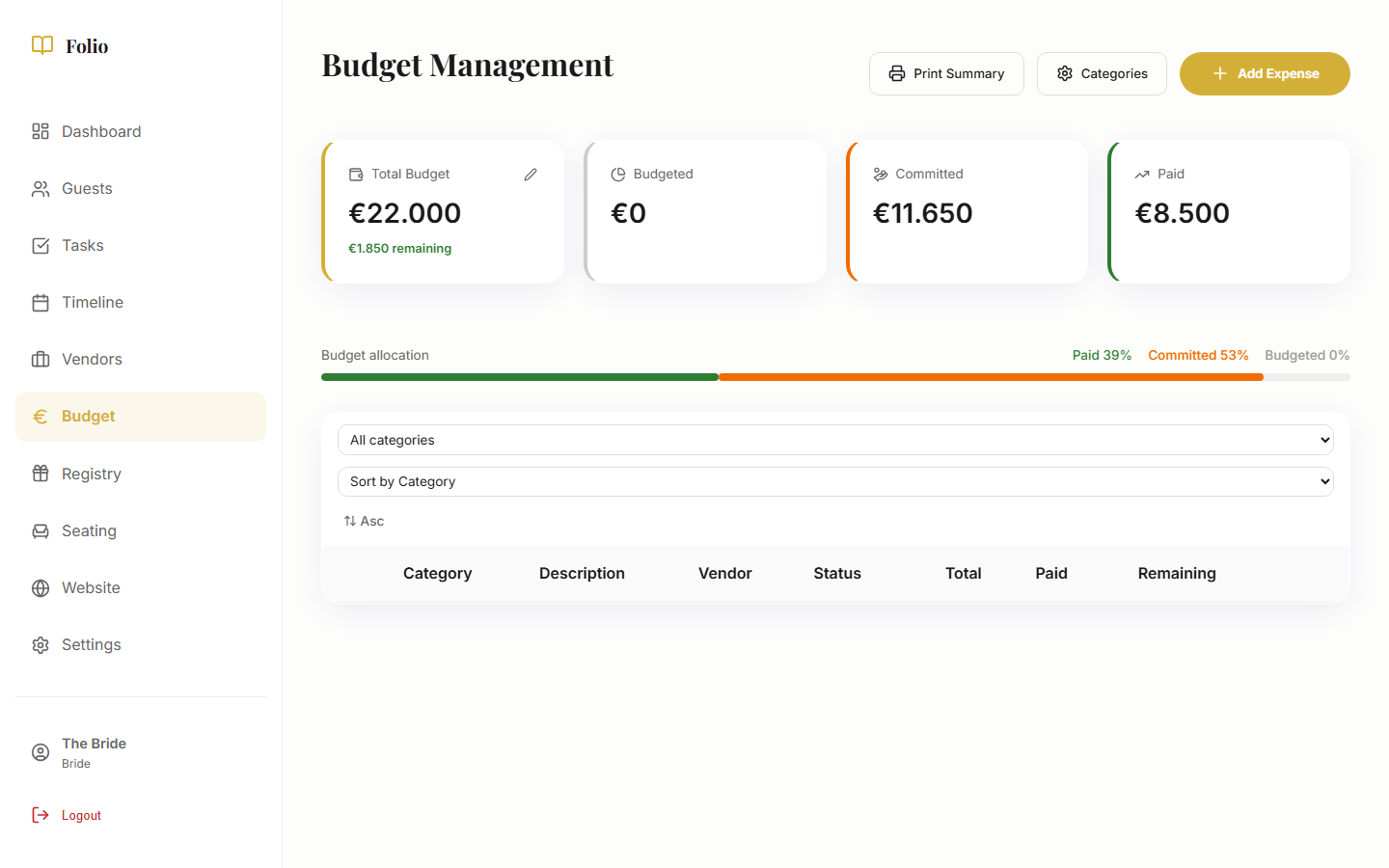
The budget is one of the features couples find most valuable in Folio. You enter vendors and costs by category, track what has been paid and what is still outstanding, and see at a glance whether you are on track.
No formulas, no broken spreadsheets, no "which tab was it again." Just an overview that adds up. And if you prefer to create a PDF to print or share with family: that works too.