Planning a Wedding: a complete guide for your big day
You are getting married. Congratulations. And now the real work begins. Because planning a wedding is a project that takes months, sometimes more than a year. Dozens of decisions are coming your way, from the venue to the flowers, from the budget to the seating chart. Some fun, others less so.
The good news: you do not have to do everything at once. Most couples plan their wedding over a period of 12 to 18 months, and if you take it step by step, it is perfectly manageable. In this guide, we walk through every aspect, from the very beginning to the day itself.
Where do you start?
The first weeks after the engagement are a mix of excitement and mild panic. Everyone has an opinion, Pinterest is overflowing with inspiration, and you have no idea where to begin. That is normal.
Start with three things:
- Decide together what kind of wedding you want. Big or small? Formal or relaxed? In a castle or in a garden? Talk about this before you start booking anything. It prevents discovering three months later that you had completely different expectations.
- Set a rough budget. How much can and do you want to spend? Are parents contributing? This determines everything that follows. Read our complete guide to wedding costs for realistic figures.
- Choose a period. Not necessarily an exact date, but a season or month. That helps when searching for venues and vendors.
The planning: when to do what?
Planning a wedding is not a sprint, it is a marathon. The key is doing the right things at the right time. Starting too early with details like place cards while you do not have a venue yet is wasted effort. Starting too late with booking the photographer means the good ones are already taken.
Below is a rough timeline. Want the full breakdown? Check our wedding checklist with 100+ tasks.
12 to 18 months before
- Set the budget
- Draft the guest list (first version)
- Visit and book venues
- Pick the wedding date
- Choose ceremony type (civil, religious, free ceremony) and think about personal vows
9 to 12 months before
- Book the photographer
- Select the caterer
- Arrange music (DJ or band)
- Choose wedding attire
- Send Save the Dates
6 to 9 months before
- Choose the florist
- Design the invitations
- Choose the rings
- Ask your MC
- Set up the gift registry
3 to 6 months before
- Send invitations
- Collect RSVPs (read our RSVP guide)
- Create the timeline
- Schedule trial makeup and tasting dinner
- Arrange transport
Last month
- Give the final guest count
- Create the seating chart
- Confirm final arrangements with all vendors
- Finalize and share the timeline
- Pick up the wedding rings
The exact order differs per couple. Some book the photographer first, others start with the venue. What does not differ: the earlier you lock in the big things, the calmer the last months will be.
Budget: how much will it cost?
The average European wedding costs between €15,000 and €25,000. But that average is not very informative if you want an intimate wedding with 40 guests, or a big celebration with 150 people.
The main cost categories:
- Venue: €500 to €8,000, depending on the type
- Catering: the biggest expense, expect €100 to €180 per guest for food and drinks
- Photography: €1,200 to €3,500
- Attire and styling: €1,500 to €4,000
- Music: €600 to €4,000
- Flowers and decoration: €500 to €2,500
Two rules of thumb: catering and venue together account for 50 to 60 percent of the total budget. And the guest count is the biggest lever. Each additional guest costs €100 to €180. In our article on wedding costs you will find detailed tables per category and guest count.
The most important thing about the budget: keep tracking it. Not just once at the beginning, but continuously. Quotes, deposits, remaining balances, unexpected costs. If you do not actively track it, you will guaranteed go over budget.
Choosing the venue
The venue is often the first big decision and sets much of the tone. A few things to consider:
Capacity. Does your guest list fit? Not just for dinner, but also for the ceremony, the reception, and the party. Some venues have separate rooms for each part.
What is included? A "cheap" bare venue can end up more expensive than a pricier venue where catering, furniture, and staff are included. Always ask what you need to arrange yourself.
Accessibility. Can guests get there by public transport? Is there parking? Do you need to arrange a shuttle?
Rain plan. If you want an outdoor wedding: what is the plan if it rains? Venues with a solid indoor alternative save you a lot of stress.
Availability. Popular venues are booked months in advance during wedding season (May to September). Getting married on a Friday or weekday gives you more choice and is often cheaper.
Booking vendors
After the venue come the vendors: caterer, photographer, DJ or band, florist, makeup artist, videographer, patissier. The list is longer than you think.
A few tips:
- Request multiple quotes. Not to pick the cheapest, but to know what is market rate. Three quotes per vendor is a good starting point.
- Read the contract. What happens if you cancel? Are there surcharges for extra hours or overtime? Is VAT included?
- Book early. Good photographers and popular bands are fully booked during wedding season. Start at least 9 to 12 months ahead.
- Stay in touch. Booking a vendor is not the end, it is the beginning. Confirm appointments, share the timeline, and call a week before the wedding to check in.
The guest list
The guest list is the foundation of your planning. The number of guests determines the venue, the catering, the budget, and the seating chart. Everything depends on it.
Start with a broad list of everyone you want to invite. Divide into day guests (ceremony and dinner) and evening guests (party only). That distinction is not just practical, it also makes a significant difference to the budget.
Tracking the guest list, RSVPs, dietary needs, and household groups quickly becomes unwieldy in a spreadsheet. Read our guide to managing your guest list for practical tips.
Collecting RSVPs
Once the invitations are out, the waiting begins. Some guests respond immediately. Others go weeks without a word. And then there are the people who let your mother know they "will probably be there," without you being able to find that anywhere.
The solution: a central system where all confirmations come together. Personal RSVP links per household work best. Guests click their link, fill in whether they are coming, how many, and any dietary needs. You see it directly in the overview. More about this in our RSVP article.
The timeline
The timeline is the timetable of your wedding day. Who needs to be where, at what time, and what happens then? From the moment the makeup artist arrives to the last dance.
A good timeline includes:
- Times for every part of the programme
- A person responsible for each part
- Contact details for all vendors
- Logistical details (what goes where, who brings what)
The timeline is not just for you. The MC, the venue, the caterer, and the photographer all need their own version. Read our complete timeline guide for an example schedule.
Seating chart
The seating chart is one of the last steps, but one of the trickiest. Who sits where? Who can sit next to whom? Who absolutely cannot sit next to whom? It is a puzzle where family dynamics, friendships, and practical considerations all come together.
Only start the seating chart once your final guest count is confirmed. Otherwise you will endlessly shuffle names that end up not coming anyway. In our seating chart guide you will find how to approach it and which pitfalls to avoid.
Gift registry
The days of the cash envelope at the wedding are not over, but more and more couples are choosing a digital gift registry. It gives guests clarity about what you want, prevents duplicate gifts, and makes it easy to contribute to larger wishes or a cash fund.
A good registry contains a mix: a few physical wishes, some cash funds (for the honeymoon, renovations, or something else), and always the option for a free contribution. Read more in our gift registry guide.
The day itself
On the wedding day itself, you should not be organizing anything. That is the whole point of all the preparation: everything is set, everyone knows what is expected, and the MC and vendors run the programme.
Still, a few tips for the day itself:
- Hand over responsibility. The MC, a good friend, or the wedding planner is the point of contact. Not you.
- Eat and drink. Sounds obvious, but many couples forget to eat at their own wedding. Deliberately schedule a moment to sit down.
- Enjoy. It goes fast. Take a moment now and then to look around and let it sink in.
Common mistakes
After hundreds of weddings, we see the same mistakes come up again and again:
Starting bookings too late. Popular vendors and venues are fully booked months in advance during wedding season. Start at least a year ahead with the big things.
No buffer in the budget. Something always costs more than expected. Set aside 5 to 10 percent for unexpected expenses.
Wanting to do everything yourself. DIY sounds fun, but it is work. Every task you take on costs time and energy. Be realistic about what you can handle alongside a job and the rest of life.
Not sharing the timeline. If the MC, the venue, and the caterer each have a different picture of the timings, something will go wrong. Share one shared timeline with everyone.
Not following up on RSVPs. There are always guests who do not respond. Schedule two reminder moments, otherwise you will be chasing people a week before the wedding.
Plan your wedding with Folio
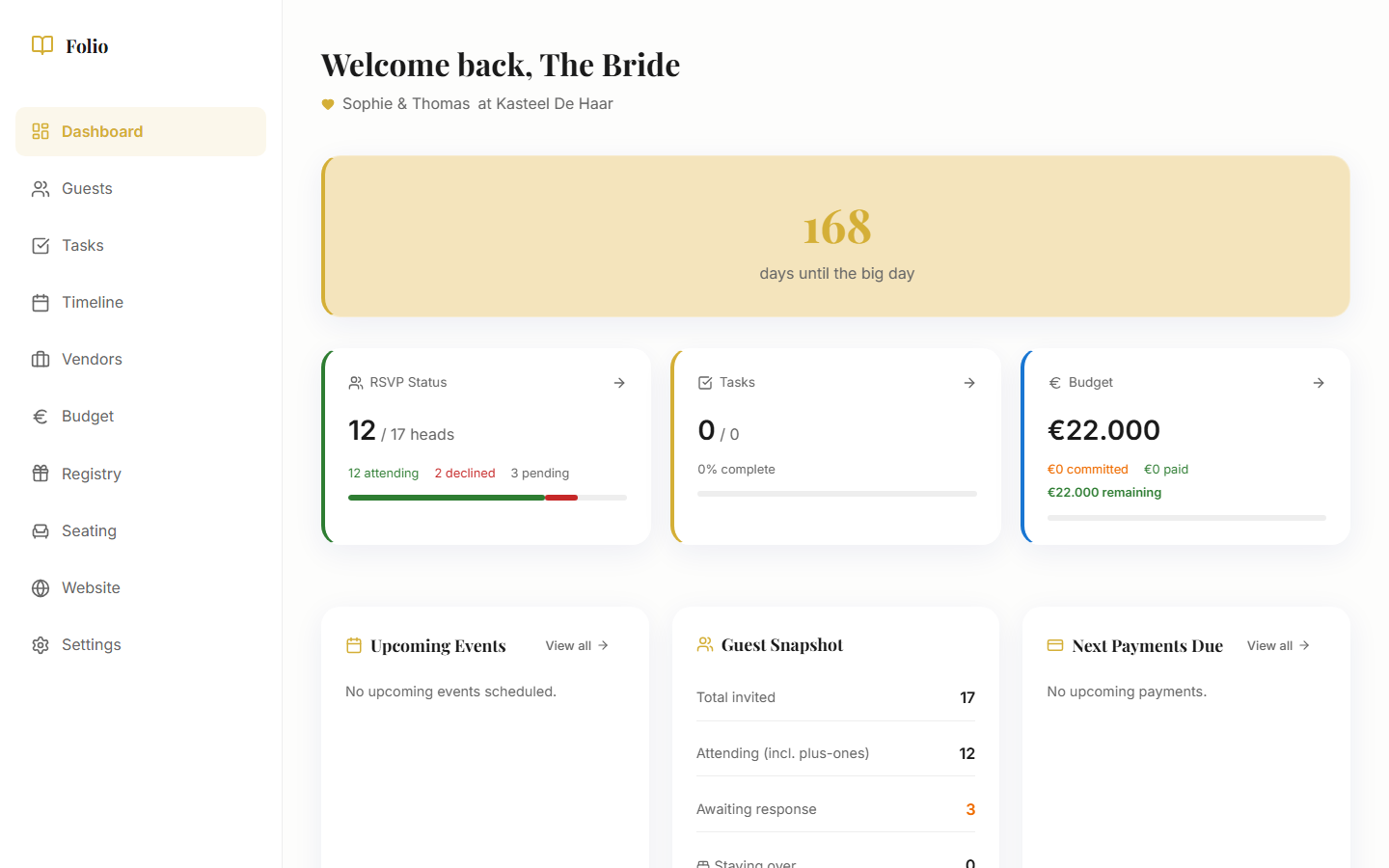
Folio brings everything together in one place: guest list, budget, timeline, seating chart, gift registry, and wedding website. No five separate spreadsheets, no group chats full of appointments you lose track of, no Pinterest boards you never find again.
You add guests, track the budget, create a timeline, and share everything with your partner or wedding planner. Guests get a personal RSVP link and fill in their details themselves. Everything is updated automatically.
Check the features or read more about how Folio works.